

A founder I talked to a while back three-person startup, accounting software for freelancers told me the onboarding process at her company basically depended on who happened to answer the door, so to speak. Some new clients got a warm, thoughtful welcome from her personally because she happened to be free that week. Others got a rushed, generic email from whoever was around, because everyone was buried in something else. Same product, wildly different first impression, and it showed up directly in early reviews. Some raving about how personal it felt. Others confused about what was supposed to happen next.
That inconsistency is basically the default state at most early-stage companies, not because anyone’s careless, but because roles overlap and nobody specifically owns onboarding. The first two weeks of a client relationship set the tone for everything after. A rocky start creates doubt that lingers for months even if the actual work turns out fine later. Startups feel this harder than big companies do, because a five-year-old brand has reputation to fall back on when something goes slightly wrong. A startup usually doesn’t have that cushion yet.
Why this hits startups specifically hard
Established companies get some patience during a bumpy start just from brand recognition alone. A new client picked the startup for a specific reason a pitch that landed, a referral, a demo that impressed them — and onboarding is the very first real test of whether that promise actually holds up. Fail that test and the doubt doesn’t go away just because the deliverables eventually turn out fine.
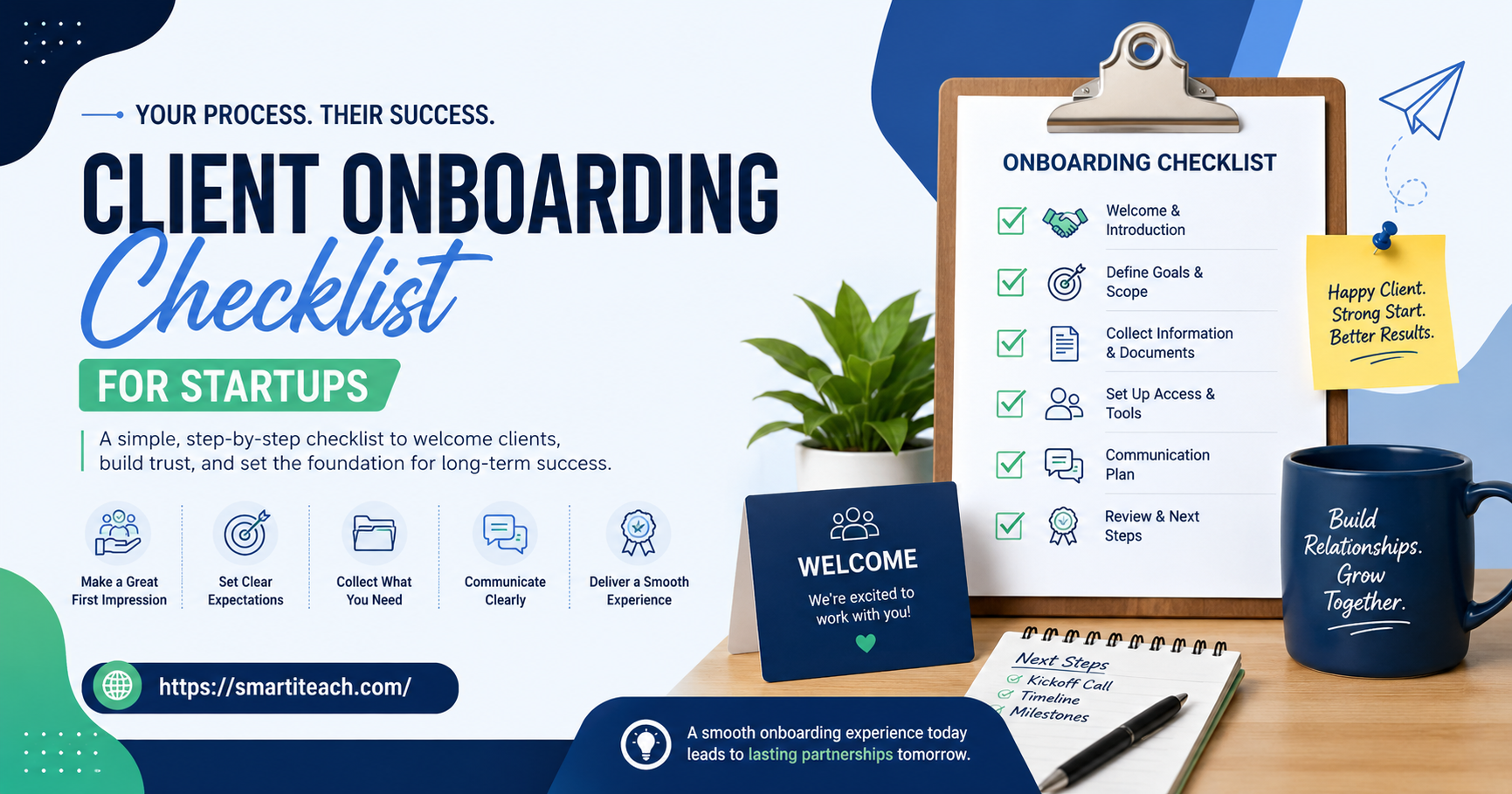
A written checklist fixes the inconsistency problem directly. Doesn’t matter who’s handling a given client that week — the steps stay the same regardless. New hires can pick up onboarding responsibilities without months of shadowing someone, because the process lives on paper instead of only in one founder’s head, which is exactly where it was living at that accounting software company before they fixed it.
What should actually be on it
Send something within hours, not days. There’s real momentum right after a contract gets signed, and a fast, personal welcome message capitalizes on that. Wait two or three days and doubt starts creeping in, quietly, even if nobody says anything about it.
Get a kickoff call on the calendar before diving into any actual deliverables. Cover goals, timelines, who’s who, communication preferences. Skipping this to “save time” almost always costs more time later when misunderstandings surface mid-project instead of getting resolved in a thirty-minute conversation upfront.
Grab all the access and information you’ll need early — logins, brand assets, background docs, whatever applies. Chasing that stuff down three weeks into a project is annoying for everyone and makes the team look disorganized even if they aren’t.
Nail down communication cadence clearly. Weekly email? Shared project board? Quick calls? Decide this early so nobody ends up in the situation where the client expects daily updates and the team assumed monthly check-ins were fine.
Give them one person to contact. Not three. Clients feel a lot more confident knowing exactly who to reach instead of getting bounced between people who each know a third of the story.
Define what success actually looks like for this specific client. “Grow the business” measures nothing. Specific, agreed-upon numbers make it far easier to show value down the line, and far easier to have an honest conversation if things aren’t going as planned.
Share even a rough project timeline. Doesn’t need to be detailed just enough that the client feels oriented instead of wondering what happens next and when.
Confirm billing clearly, upfront, in writing. Confusion over money kills trust faster than almost anything else, and assuming the sales conversation already covered it thoroughly is usually a mistake.
Check in after the first deliverable goes out. A short conversation right after the first real piece of work catches small issues before they turn into bigger complaints, and it tells the client their feedback actually matters to someone.
Back to that founder for a second
Once they wrote all this down nine steps, welcome message through first milestone check-in — nothing fancy, just a shared doc anyone on the team could follow without asking questions. Complaints related to onboarding dropped noticeably within two months. Several new clients specifically mentioned, unprompted, how organized things felt compared to other vendors they’d looked at. No new hires. No new software. Just a process that used to live in one person’s head, written down so everyone followed the same version of it.
Where this goes wrong
A lot of startups dump too much on a client at once. Five documents, three login requests, and a novel-length welcome packet on day one overwhelms people instead of reassuring them. Spreading things out over the first week or two, tied to specific next steps, works a lot better than one big information dump on day one.
Skipping the kickoff call feels efficient in the moment. It rarely is. Projects that launch without a real conversation about goals tend to hit misalignment issues later that eat up far more time than the thirty minutes that call would’ve taken.
Some teams also just don’t assign clear ownership. Three people touching a new client’s onboarding without coordinating means the client gets conflicting information or has to explain their situation three separate times, which gets old fast.
And plenty of companies treat onboarding as a one-time event rather than an ongoing relationship, when really the first month or two deserves more attention than routine account management ever gets, because this is exactly when someone decides what working with you is actually going to feel like long-term.
Keeping it from just sitting in a drawer
A checklist only helps if people actually use it, consistently, every single time. Where it lives matters less than whether people actually check things off shared doc, project management tool, whatever. Revisit it every few months too. What worked with three clients and five employees probably needs adjusting once there are thirty clients and fifteen people. Treat it as something that evolves, not a policy carved in stone somewhere nobody looks at again.
Why it’s worth the effort
Onboarding rarely gets much attention at fast-moving startups, where energy naturally goes toward the product or the next sale. But it’s exactly where a client either becomes someone who sticks around and refers people, or starts quietly looking for a reason to leave. A checklist costs almost nothing to build and stays consistent even as the team grows and people’s roles shift around.
For a startup up against bigger, more established competitors, a smooth onboarding experience becomes a real edge. People notice organization. They notice the right follow-up landing at the right moment. Building that discipline early — through something as unglamorous as a checklist pays off well past the first couple weeks of any client relationship.




[…] needs to scale with how often you sign contracts a freelancer signing four a month shouldn’t pay enterprise rates. Speed matters, since a tool that takes twenty […]
[…] a founder spend six weeks building a referral program nobody asked for. Six weeks. Meanwhile his onboarding email the one thing every single new customer actually saw sat broken, sending people to a 404 page. […]
[…] a business has been running because your existing relationships have trust already baked in. A brand new client has to be convinced from zero. An existing client already believes in you, at least a little, or […]