

I once watched a founder spend six weeks building a referral program nobody asked for. Six weeks. Meanwhile his onboarding email the one thing every single new customer actually saw sat broken, sending people to a 404 page. Nobody caught it because nobody was looking at the boring stuff. They were too busy chasing the exciting stuff. That’s basically the whole problem with early-stage growth. You end up doing what feels productive instead of what actually moves numbers.
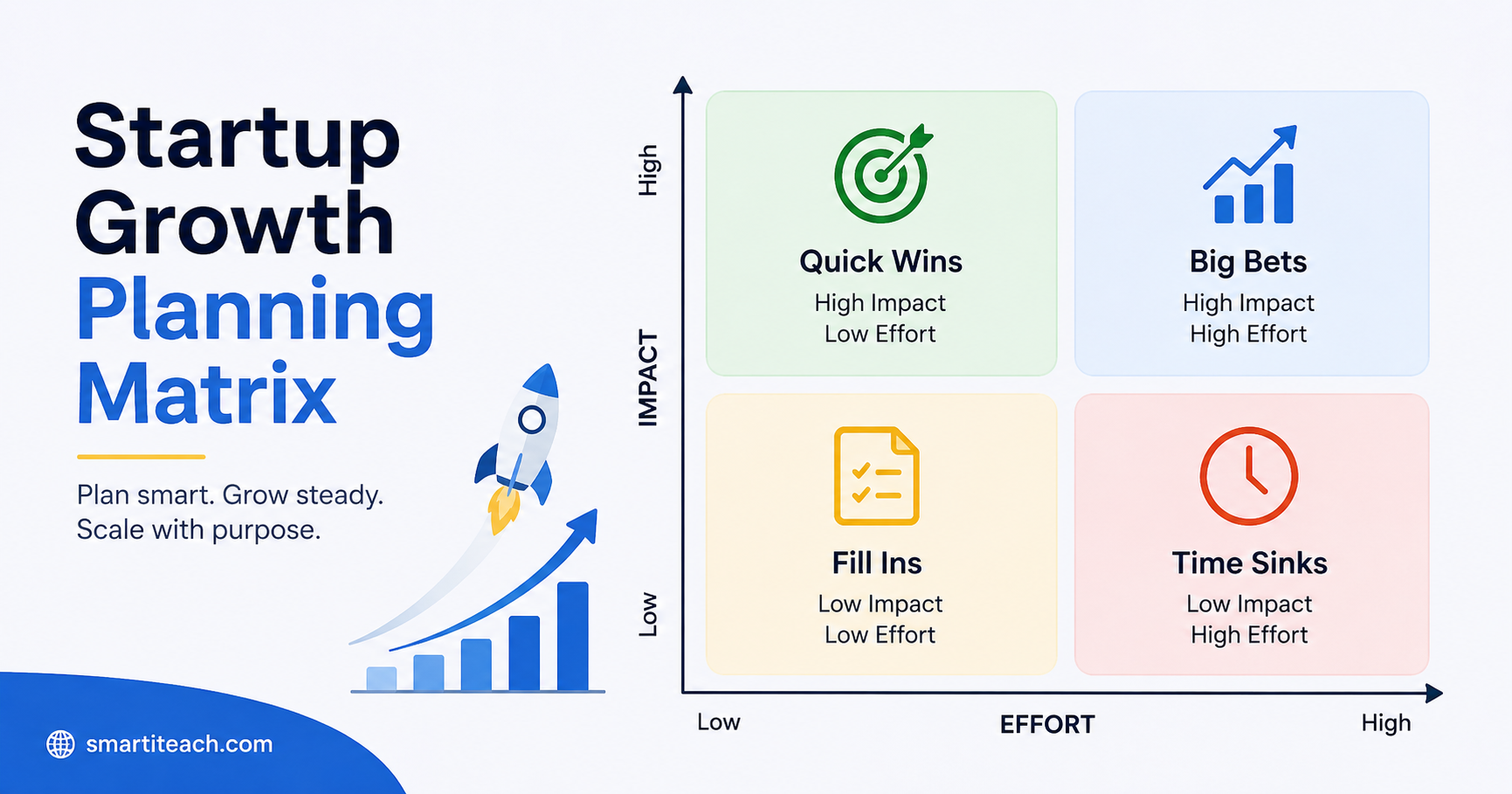
A growth planning matrix fixes that, or at least it fixes it most of the time, because let’s be honest, no tool fixes a founder who genuinely refuses to say no to shiny objects. But for the rest of us, it works. It’s just a grid. Impact on one side, effort on the other. You throw every idea you have onto it and suddenly the six week referral program looks like what it actually was: low impact, high effort, a total waste.
So What Is This Thing, Actually
Picture a square. Cut it into four boxes. Top left is high impact and low effort those are your gold. Bottom right is low impact and high effort, and that’s where dreams go to die, or at least where your time goes to die. Top right is high impact but it’ll cost you real effort, so you plan those carefully, you don’t just wing them. Bottom left, low impact and low effort, those are fine to do on a slow Friday but they’re not going to save your company.
That’s it. That’s the whole concept. People make it more complicated than it needs to be, honestly. I’ve seen consultants charge thousands of dollars to walk founders through something you could sketch on a napkin in four minutes.
Why Founders Avoid Doing This
Because it feels like admitting defeat, weirdly. Sitting down to plan feels slow. It feels like the opposite of hustle. And early on, hustle actually does work you’re small, you’re scrappy, you can outrun your mistakes. But there’s a point, and it’s different for every company, where the outrunning stops working and the mistakes start catching up. Usually that’s around the time you hire your fifth or sixth person and things start slipping through cracks that used to just be you remembering everything in your head.
I talked to a SaaS founder last year who told me her team was “too busy to plan.” I asked what they were busy doing. She listed maybe eight different initiatives. I asked how many of those were tied to an actual growth number they cared about. She got quiet. Two. Two out of eight. The other six were things that felt important but weren’t actually connected to anything measurable.
That’s the trap. Busy does not equal effective. It just feels that way because you’re tired at the end of the day and tired feels like proof of work.
Building Your Own Matrix This Week
Here’s how I’d do it if I were you, and honestly this takes less time than most people think.
Grab a whiteboard, or a Google Doc, or the back of a napkin, doesn’t matter. Write down every growth idea currently floating around your team. Every single one. The Instagram campaign someone’s cousin suggested. The partnership deal that’s been “almost happening” for three months. The new pricing tier. The referral program. All of it.
Now for each one, ask two questions. First: if this works exactly as planned, how much does it actually move revenue or retention or whatever metric you care about most? Be honest. Not hopeful. Honest. Second: how much time, money, and attention does this actually eat up, including the meetings about it, because meetings count too and everyone forgets that.
Plot each idea. You’ll notice something almost immediately. A lot of your “urgent” projects land in that bottom right box, the wasteland. That’s normal. It happens to almost everyone the first time they do this exercise, and it’s a little uncomfortable to see it laid out so plainly.
Cut those. Or at least pause them. You don’t have to kill them forever, some ideas that are low impact now might become high impact later once you have more customers or more data. But right now, today, they’re not worth your attention.
A Quick Story About What Happens When You Actually Use It
A friend of mine runs a small e commerce brand, nothing huge, maybe two million a year in revenue. She was drowning. New product launches every month, three different ad platforms running simultaneously, an influencer program she’d started almost by accident after one TikTok video went semi-viral. She felt like she was sprinting constantly and somehow still losing ground.
We did the matrix exercise on a call, took maybe forty minutes including the part where she got distracted by her dog barking at a delivery truck. Turned out her influencer program, the thing eating the most hours of her week, was landing squarely in low impact territory. It felt exciting because it felt viral and modern, but the actual sales attributed to it were tiny compared to her email list, which she’d been neglecting because email felt boring and old-fashioned.
She cut the influencer program down to almost nothing. Redirected that time into email flows and abandoned cart sequences, unglamorous stuff, genuinely unglamorous. Three months later her email revenue had grown by around forty percent. Not because email is magic. Because she finally put her limited hours where the impact actually lived instead of where the dopamine lived.
Revisit It, Don’t Just Do It Once
Here’s a mistake people make constantly. They build the matrix once, feel very accomplished, and then never look at it again. Six months pass. The market shifts. Suddenly half the things in your “high impact” box aren’t high impact anymore because your business has changed, your customers have changed, maybe your whole product has changed.
Set a recurring date, monthly or quarterly depending on how fast your company moves, and redo it. Doesn’t need to take long once you’ve done it the first time. Twenty minutes, maybe thirty if there’s a lot of debate.
And there will be debate, by the way. Founders and their teams often disagree wildly about what counts as high impact. Your head of sales might think a new CRM integration is critical. Your head of product might think it’s a distraction from shipping features. Neither is necessarily wrong. That’s actually the value of doing this together as a group, not alone in your own head — the disagreement surfaces assumptions that were never actually said out loud before.
What This Actually Buys You
Clarity, mostly. Less arguing in circles during meetings because you have something concrete to point at instead of vibes. Fewer late nights spent on projects that, if you’re being honest with yourself, were never going to matter that much anyway.
It also buys you something harder to quantify, which is permission. Permission to say no. A lot of founders struggle to turn down opportunities, even bad ones, because saying no feels risky, feels like leaving money on the table. But when you can point to a matrix and say “this is in the low impact box, we already agreed on this,” it stops being a personal decision and starts being a system decision. That’s a lot easier to defend, both to your team and to yourself at two in the morning when you’re second-guessing everything, which, let’s be real, every founder does eventually.
Where People Screw This Up
Two big mistakes I see over and over.
First, people overthink the placement. They spend forty minutes debating whether something is “medium-high” impact versus “high” impact. Don’t. The matrix doesn’t need to be precise, it needs to be directionally useful. If you’re arguing about a fine distinction like that, it probably belongs in the middle anyway and the exact spot doesn’t matter much.
Second, people forget to include the boring stuff. Everyone loads the matrix up with flashy growth ideas — new features, marketing campaigns, partnerships. Nobody adds “fix the broken onboarding email” or “respond to support tickets faster.” Those boring items are often sitting quietly in the high impact, low effort box, and they get skipped because they don’t feel like growth work even though they absolutely are.
Go back through your matrix right now, actually, and ask yourself if you included the unglamorous stuff. If you didn’t, add it. That’s usually where the easiest wins are hiding.
Growth doesn’t come from working harder in every direction at once. It comes from figuring out which direction actually matters and then, honestly, having the discipline to ignore the rest, even when the rest looks exciting. The matrix won’t do the discipline part for you. But it’ll at least show you clearly what you’re choosing to ignore, which is more than most founders ever get.



[…] Businesses without a clear position usually end up competing on price, which is a race nobody actually wants to win, because it just erodes margin over time. Strong positioning lets a business charge a fair price because customers already believe there’s a real difference worth paying for. […]