
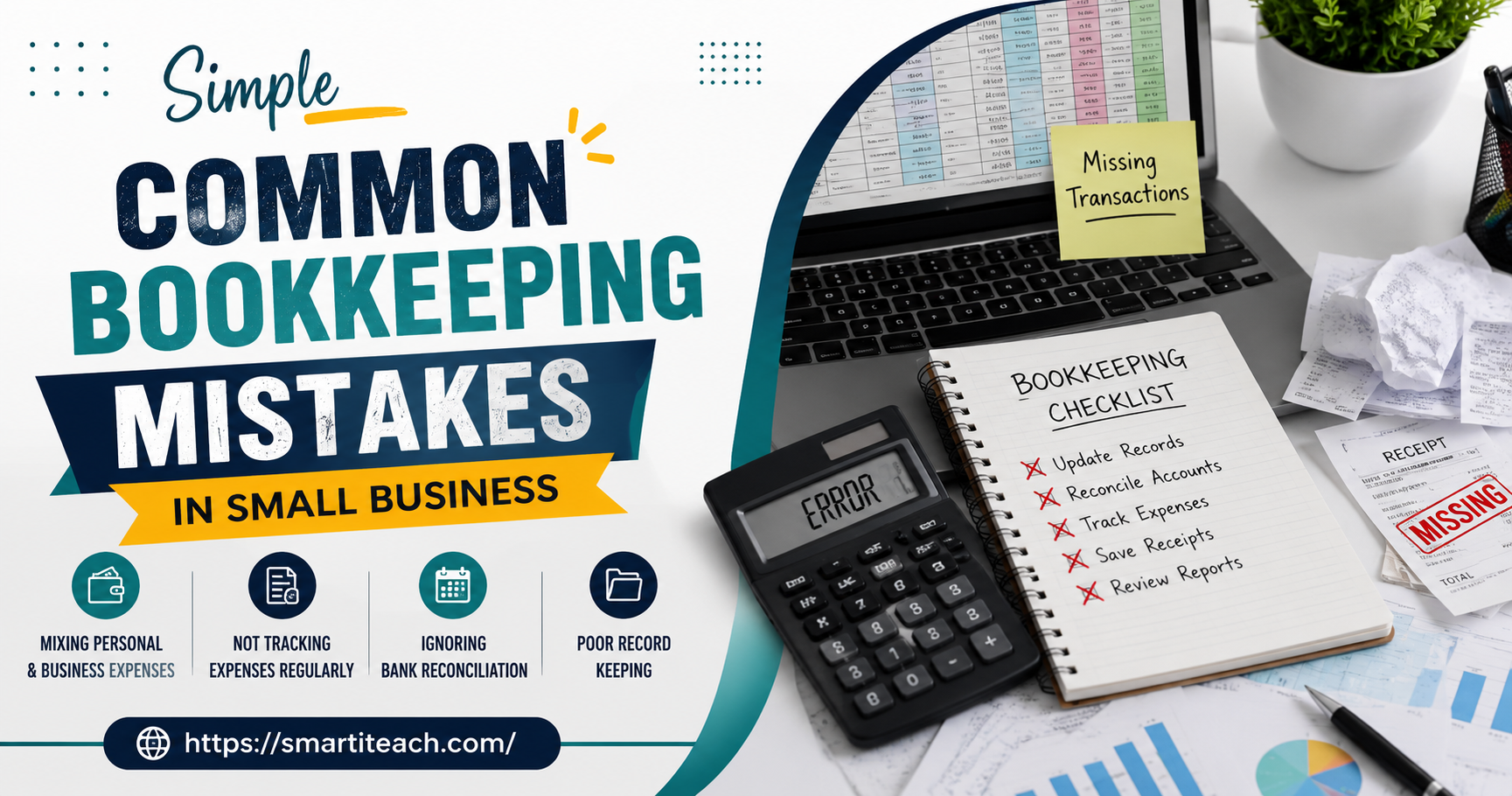

Ask ten small business owners how their books look right now. At least seven will laugh before they actually answer. Not because they’re bad at business — most of them run a genuinely good one — but because bookkeeping is the first thing that gets shoved to “later.” You’re chasing invoices, fixing whatever broke this week, answering three client emails at once. Somewhere in that mess, receipts pile up in a drawer. Nobody opens the bank feed for three weeks. Then a month. Then it’s a problem.
Most bookkeeping mistakes aren’t really about math. They’re habits. Small ones. A skipped week here, an “I’ll sort that later” there, and eventually nobody’s totally sure what the numbers mean anymore. That’s the pattern, over and over, in almost every small business I’ve come across.
The good part? None of this requires becoming an accountant. It just means noticing which habit is the problem and fixing that one first.
Mixing Personal and Business Money Together
This is the one everyone mentions first. For good reason.
It starts small, almost always. The business account isn’t open yet, so a personal card covers the first few purchases. Fine. Then it happens again the next week. Six months in, nobody can say for sure which transactions were “the business” and which were just life happening. Groceries sitting right next to office supplies on the same statement — good luck sorting that out in April.
The real damage isn’t the mess. It’s that you lose an honest read on how the business is actually doing. And come tax season, someone has to go line by line untangling it, at the exact moment they have the least patience for that.
Fix: open a separate account and card, even if it’s just you. Run every business dollar through it — supplies, subscriptions, the client lunch, all of it. Slip up and grab the wrong card? Log it immediately and reimburse yourself so it still shows up cleanly on the business side.
One more thing worth doing — stop paying yourself informally by just pulling cash whenever you need it. Set an actual owner’s draw or a fixed transfer instead. Small distinction. Huge difference once you try to figure out what the business actually earned versus what you personally spent.
Skipping Regular Reconciliation
Reconciliation means checking your books against the actual bank statement to make sure they agree. Not thrilling stuff. Also one of the easiest things to just… stop doing.
Skip it long enough and small errors stop staying small. A duplicate entry here. A missed transaction there. A bank fee nobody noticed. None of it surfaces until months later — if it surfaces at all.
Put a recurring reminder on the calendar. Weekly, ideally. Monthly at the very least, and don’t let it slide past that. Software can pull the bank feed automatically, sure, but someone still needs to actually look at it.
There’s a security side to this too, one people don’t think about until it’s too late. Reconciling regularly is often how a fraudulent charge or a vendor billing error gets caught in the first place. Only look once a year, and a bad charge from month two could sit there quietly for the better part of that year.
Brushing Off Small Transactions
A lot of owners are careful with the big stuff — the big invoice, the big purchase — and sloppy with the small stuff. A $6 parking fee. A $15 coffee with a client. Not worth the effort, right?
Wrong, actually. Small expenses pile up faster than people expect, and unevenly too. Careful with the big numbers, careless with the small ones — that doesn’t get you “mostly accurate” books. It gets you books that are wrong in a specific, sneaky way that’s hard to spot later.
Record it all. Every last bit of it. If the software’s already pulling from your bank feed, this is mostly just categorizing what’s already sitting there, not typing each line by hand.
And here’s the part people miss: small transactions are often the clearest tax deductions available. Parking, tolls, client meals, small subscriptions. Skip logging them for a full year and you might be leaving real deductions on the table — just because nobody bothered with a handful of small purchases.
Miscategorizing Expenses
Even the owners who log everything can trip over this one. A marketing cost filed under office supplies. A personal draw lumped in with payroll. Looks minor. Isn’t.
Miscategorized expenses quietly distort your reports. Wrong buckets can make it look like a marketing spend isn’t working, so you cut it — when really it’s the numbers that were wrong, not the marketing. It also complicates taxes, since categories get treated differently.
Set up a proper chart of accounts early on, one that actually matches how your business runs — not just whatever came pre-loaded in the software. And if something doesn’t clearly belong anywhere? Ask. Don’t guess and hope.
Worth revisiting those categories every few months, too. Businesses grow, new kinds of expenses show up, and if the chart of accounts never gets updated, everything new just gets crammed wherever’s closest. The whole system gets a little less useful every time that happens.
Falling Behind on Invoicing
This one hits cash flow, directly and immediately. Work gets finished, invoice doesn’t go out. Sometimes it’s discomfort asking for money. Sometimes it’s just — busy. Either way: delayed invoice, delayed payment.
It also gets harder to track who owes what. An unpaid invoice from three months back can genuinely vanish from memory if nothing’s tracking it for you.
Send the invoice the same day the work wraps, whenever you can manage it. Use software that tracks what’s outstanding and sends the reminders automatically — so you’re not the one sending an awkward “just checking in” email every single time.
Clear terms matter here too. A vague or missing due date gives people an easy excuse to pay whenever. Spell it out: due date, accepted payment methods, any late fee. No ambiguity once it lands in someone’s inbox.
Losing Track of Receipts
“I’ll remember what this was for.” No, you won’t. Not in three months. Definitely not two years from now if you ever get audited.
Receipts end up stuffed in wallets, glove boxes, random email folders — never actually logged anywhere. Tax season rolls around and it’s a frantic scramble to reconstruct months of spending off memory and faded thermal paper.
Snap a photo the second you get the receipt. Attach it to the transaction right there in the app. Takes maybe ten seconds, saves you a much bigger headache down the line.
This matters even more if you’re ever audited — tax authorities want proof behind a deduction, not just a line item claiming it happened. A digital receipt attached at the time of purchase beats a reconstructed memory every single time.
DIY Bookkeeping Without Any Real System
Doing your own books isn’t the mistake. Doing it with zero consistent system is. Spreadsheets that don’t follow any format. Apps opened once, then abandoned. Notes scattered across three different places. That’s what actually causes the trouble.
No structure means bookkeeping only happens when something forces it — a deadline, a loan application, a moment of panic about making payroll.
Pick one simple system. Stick with it. A basic tool used every week beats a fancy one that gets ignored after month one. It doesn’t need to be impressive at the start. It just needs to be something you’ll actually open.
And if you ever bring in a bookkeeper down the line, having even a basic consistent system beforehand makes that handoff so much smoother. Cleaning up a year of scattered records before anyone else can even start working with them — that’s a common, and entirely avoidable, expense.
Overlooking Sales Tax Obligations
Sales tax rules shift depending on where you are and what you’re selling, and it’s easy to get quietly wrong. Some owners forget to collect it early on. Others collect it, then spend it — so when it’s time to remit, the money’s just gone.
Figure out your obligations before the first sale, not after. Keep anything collected in a separate account. That money was never really yours to spend in the first place.
Selling across state lines, or online to customers in different regions? Worth checking whether you’ve crossed a threshold requiring you to collect somewhere new. These rules shift as a business grows, and it’s easy to miss the exact point where a new obligation kicked in.
Not Backing Up Financial Records
Easy to assume the data’s safe just sitting in an app. Then a laptop gets stolen, a drive fails, a file gets deleted by accident. Losing financial records isn’t just annoying — it can turn into a real legal or tax problem.
Use cloud-based software that backs up on its own, and keep a second backup if anything’s stored locally. Also worth exporting key reports every quarter — profit and loss, balance sheet — and tucking them somewhere separate from the main system. Just in case.
Only Looking at the Books at Tax Time
Probably the most common mistake on this whole list. Plenty of owners only really open their books once a year, right before taxes are due — which means eleven months go by with zero real picture of where the business stands.
It’s not just a tax problem either. Decisions about hiring, spending, pricing — all of it gets made blind, without knowing whether the business can actually support any of it.
Check the books monthly, at minimum. Even a quick look at income, expenses, and cash flow. That single habit turns bookkeeping into a tool you actually use, instead of a chore you dread once a year.
None of this requires becoming a numbers person overnight. Pick whichever mistake on this list felt a little too familiar, fix that one first, let it become routine, then move to the next. Small, steady changes beat one big overhaul — and a year from now, your books (and probably your stress levels every April) will look nothing like they do today.




[…] your team feels constantly busy but somehow never catching up, the problem is probably not effort. People are working plenty hard. The workflow itself is quietly fighting them. Here’s what I’ve actually seen help, […]