
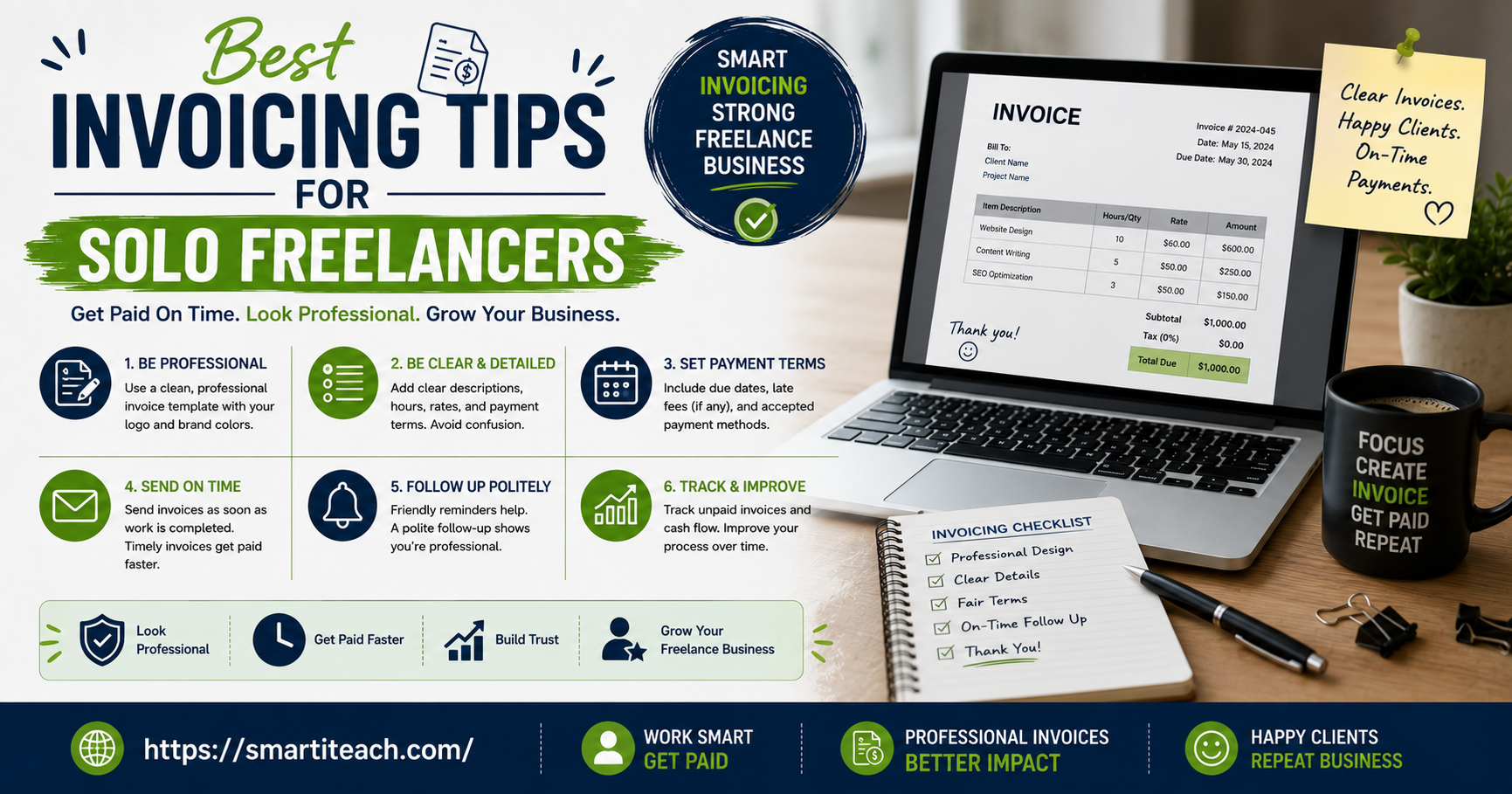

I’ve been freelancing long enough to know that the actual work is rarely the hard part. Writing the copy, building the site, editing the video, whatever it is you do — that’s the part you’re good at. What trips people up is the invoice. The thing that’s supposed to be simple ends up being the reason you’re refreshing your bank app three times a day wondering where your money went.
So let’s just talk about invoicing. Not marketing yourself, not finding clients, not scope creep. Invoicing.
Set the Terms Before You Start Anything
Most invoicing problems don’t start at the invoice. They start weeks earlier, when nobody bothered to nail down the terms.
Before you write a single line of the project, get clear with your client on:
- What exactly you’re being paid for
- Your rate — hourly, flat, milestone, whatever
- When payment is due after you invoice
- What currency, if you’re working across borders
- Whether you need money up front
You don’t need a lawyer for this. An email that says “just confirming — flat fee of $1,800, half up front, rest on delivery, Net 15 after that” is enough. It gives you something to point back to later if a client suddenly develops amnesia about what was agreed.
Ask for Money Up Front on Bigger Jobs
If a project is going to eat a few weeks of your calendar, ask for a deposit. Every contractor, every consultant, every agency does this. There’s no reason freelancers should be the one group in the service industry expected to work for free until the finish line.
Somewhere between a quarter and half of the total, paid before you start , does two things. It weeds out clients who were never going to pay anyway, and it means you’re not the one floating someone else’s project on your own savings.
Make Your Invoice Impossible to Misread
Use the Same Format Every Single Time
Clients who work with a handful of freelancers process invoices faster when the invoices look familiar. If yours looks different every month, you’re making someone re-learn how to read it every time. Pick a layout and stop touching it.
Number Them Properly
This one’s boring, I know, but a simple sequence like 2026-014 saves you real time at tax season and makes it obvious to anyone on the client’s end which invoice is which.
Say Exactly What You’re Billing For
“Design work — $2,200” tells nobody anything. If someone in accounts has to guess what that means, your invoice gets set aside while they figure it out, and “set aside” can quietly turn into three weeks.
Break it down instead:
- Homepage redesign — 14 hours at $150/hr
- Two rounds of revisions, per the agreement
- Stock photo licensing, billed at cost
Nobody has to email you back asking what they’re paying for.
Include the Boring Details Nobody Remembers to Add
Your legal or business name. Contact info. The client’s correct billing details. An actual due date, not “30 days from whenever.” Your payment details. Any tax numbers your country requires.
Miss one of these and you’ve added a whole email exchange to your payment timeline, just to fill in the blank.
Timing Matters More Than People Think
Send the Invoice the Same Day
Not tomorrow. Not “this week.” The day the work is done. A lot of companies only run payments on certain days of the month, and missing that window by 24 hours can cost you weeks, not days.
Learn When Your Client Actually Pays
Ask early on how their payment cycle works. Some finance departments run once a month, some run weekly. If you know the rhythm, you can time your invoice to land right before the next run instead of right after it.
Pick a Due Date That Actually Works for You
Net 30 is the default everyone falls back on, but it’s worth asking whether it’s actually serving you. If cash flow is tight, Net 15, or even due-on-receipt for smaller clients, is a perfectly normal thing to ask for. Most clients won’t blink.
Remove Every Excuse Not to Pay You
Give Clients More Than One Way to Pay
If you only take bank transfers but your client would rather pay by card, you’ve just added a step between “I want to pay this person” and the money actually landing in your account. A couple of payment options is usually enough to close that gap.
Switch From Spreadsheets Once You Outgrow Them
A spreadsheet invoice is fine when you’ve got two clients. Once you’ve got ten, it becomes the reason you lose track of who owes what. Invoicing software tracks due dates, sends reminders automatically, and often lets a client pay with one click straight from the invoice. That one click matters more than it sounds like it should.
Keep International Payments Simple
If you bill across borders, state your currency clearly and use a platform that handles conversions without eating half your invoice in fees. Ambiguity about currency is a very easy excuse for a client to sit on a payment a little longer.
What to Do When Payment Is Late
Remind Clients Before the Due Date, Not After
A short note a few days before something’s due — “just a heads-up, invoice #2026-014 is due Friday” — often stops it from ever becoming late in the first place. It reads as helpful, not naggy.
Have a Follow-Up Plan Ready in Advance
Don’t improvise this in the moment. Have something like this ready to go:
- A friendly nudge shortly after the due date passes
- A firmer message a week or two later, pointing back to the original terms
- A final note mentioning any late fee, if it’s still unpaid
Keep it calm. Most late payments are administrative mix-ups, not people trying to stiff you, and a sharp tone tends to make things worse, not faster.
Put a Late Fee in Your Contract From Day One
A late fee clause works less because anyone expects to actually pay it, and more because just knowing it exists moves your invoice up the priority list. Even something small, like 1.5% a month, clearly written into your agreement, changes how quickly people act.
Be Willing to Pause Work
If a client is consistently late and reminders aren’t landing, it’s fair to hold further work until they’ve caught up. That’s not you burning a bridge — that’s you protecting your own business. A client who respects your time will understand. One who doesn’t was probably never going to be a good long-term client anyway.
Back Every Invoice With a Contract
An invoice on its own is just a request. A contract is what gives that request teeth. If a client ever pushes back on an invoice, questions the rate, or claims they never agreed to a deadline, the contract is what settles it, not a memory of a phone call from six weeks ago.
You don’t need anything elaborate. A short agreement covering the scope, the rate, the payment schedule, and what happens if payment is late is enough for most freelance work. The point isn’t to look like a law firm. It’s to make sure that if a dispute ever comes up, you’re not relying on someone else’s goodwill to get paid what you’re owed.
It also makes your invoices easier to write, honestly. When the contract already spells out the rate and the schedule, the invoice just becomes a restatement of something the client already signed off on, which is a much easier thing for them to approve quickly.
Watch Out for the Small Mistakes That Slow Everything Down
A few things trip up freelancers over and over, and none of them are complicated to fix once you notice them.
Sending an invoice with a typo in the total is one. It sounds minor, but a mismatched number between your invoice and your contract is exactly the kind of thing that gets an invoice flagged for review instead of paid.
Forgetting to attach the invoice, and just writing the amount in the body of an email, is another. Some finance departments won’t process a payment without an actual invoice document attached, no matter how clearly you spelled it out in the message.
Billing in vague date ranges instead of exact numbers is a third. “Work done throughout March” invites questions. “42 hours logged between March 3 and March 28” doesn’t.
None of these mistakes are dramatic, but each one adds a day or two of back-and-forth, and those days add up over a year of invoices.
Handling Taxes and Currency Without the Headache
If you’re VAT registered, GST registered, or dealing with any local tax requirement, that information needs to be on the invoice itself, not something you mention afterward. Clients in many countries can’t legally process a payment without your tax details listed correctly, so this isn’t optional paperwork — it’s often the difference between getting paid this week or next month.
For freelancers working with international clients, always spell out the currency next to every number on the invoice, not just at the top. “$2,000” reads differently depending on whether that’s USD, CAD, or AUD, and letting a client assume the wrong one is an easy way to get underpaid without anyone intending it.
If you’re regularly converting between currencies, keep an eye on the fees your payment platform charges. A transfer fee that eats 3 or 4 percent of an invoice might not sound like much on one payment, but across a year of international clients, it adds up to real money you never see.
Keep Track of Everything
Run a Simple Payment Log
Track every invoice you send: date sent, amount, due date, date actually paid. Doesn’t need to be fancy. Over a few months, this tells you exactly which clients pay on time and which ones need chasing, which is useful when you’re deciding who gets priority on your calendar.
Check In on Your Own Habits Every Few Months
Every quarter, take ten minutes and look back. Is one client always late? Is Net 30 actually hurting you? Should you add a payment method? Treating invoicing like something you tune, rather than something you just tolerate, is the actual difference between freelancers who get paid on time and freelancers who don’t.
Why This Is Worth the Effort
Invoicing is the one part of freelancing that turns your hours into your rent, your groceries, your savings. It deserves more care than the five minutes most of us give it right before we send it off. A clearer invoice, an earlier send, a firmer follow-up — none of it feels like much on its own, but stack it over a year and it can shave weeks off how long you’re waiting on money that’s already yours.
You didn’t go freelance to spend your evenings writing polite-but-annoyed emails asking where your payment is. Get the invoicing right, and it stops being the most frustrating part of the job. It just becomes one more thing that quietly works.




[…] be honest, when people ask me how to “grow their business,” my first thought is always: grow it compared to what? Most beginners aren’t stuck […]